| |
|
|
Terri-Anne Wilson was only six when she wrote:
“When I grow up, I am going to be a teacher”.
It was a natural choice. Her mother and grandmother before
her had been teachers. Twenty years later, Terri-Anne found
herself standing in front of a grade one class at an inner
city school in Surrey, British Columbia, Canada which has
a reputation for having many students ‘at risk’
within its population. Terri-Anne’s grade one class
was no exception. Not surprisingly, many of them demonstrated
startlingly high instances of low self worth, self-loathing,
apathy and a sense of helplessness. It wasn’t long before
Terri-Anne became acquainted with a grade five teacher at
the school by the name of Terry Symonds. It was Symonds that
first introduced her to a very special Cambodian teacher by
the name of Monn Sokchea who was trying to make a difference
in the lives of his people. His goal: to create a school for
children too poor to afford quality education and to provide
a choice to parents growing weary of the corruption and inadequacies
of government run schools. His vision inspired Terri-Anne
so substantially that she began to think of ways she could
help both the victimized children of the Killing Fields along
with the children she faced in her classroom on a daily basis.
A plan began to materialize which was to address many issues
of social responsibility that are part of the curriculum delivered
at inner city schools across Canada. Wilson needed a way to
teach social responsibility to her students in a way that
was meaningful to everyone regardless of culture and in spite
of the language barriers that inevitably present themselves
in a class with a high and diverse ESL population. She also
felt a great need to reach out and help her colleague on the
other side of the globe.
|
 |
|
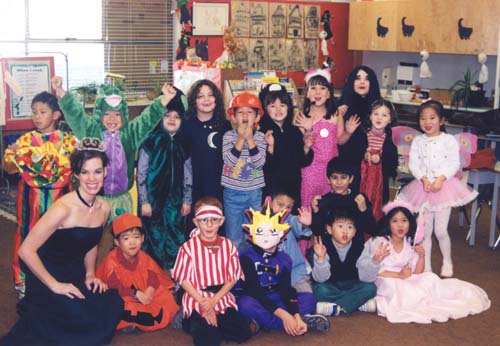
In October of 2002, Terri-Anne gathered her class together and told them of
the plight of the Cambodian people: limited resources, a war
torn country, corrupt practices. The students were asked if
they wanted to find a way to help. A brainstorming session
followed, in which many suggestions were made. Getting school
supplies to ship to Sokchea’s new little school seemed
a good place to start. The grade fives wrote letters to STAPLES
and asked for the donation of pencils, paper and anything
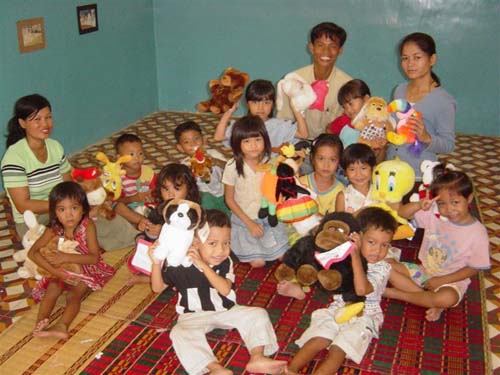
else the company cared to contribute. Next came a teddy bear
drive, where students dedicated themselves to asking for,
and packaging teddy bears for shipment to Cambodia so that
each student at the school could have their own cuddly toy.
A variety of other fundraisers ensued: raffles, concession
sales, a penny drive. The modes of philanthropy picked up
momentum and urgency when the students learned that the landlord
who owned the building the Cambodian school was in, planned
to kick its occupants out to establish a business for profit.
The struggling school was bought time when the chips fell
in their favour: the Thai Embassy had been burnt to the ground.
The political climate in Phnom Penh was volatile and not suitable
to the creation of a Thai business venture. The businessman
put off his plans and the school was spared. Temporarily.
A sigh of relief was heaved by the Canadians.
|
 |
| Meanwhile, particular Canadian students had
begun to show remarkable improvement at school. Ten year old
Sharla had come into the world as the product of a rape. After
struggling with the decision, her mother had decided not to
terminate the pregnancy. Sharla and her family are working
hard to overcome challenges of their own, including poverty
and experiences with a man who is now being charged for a
variety of crimes committed while sharing a roof and relationship
with Sharla and her mother. Sharla has put a great deal of
effort into the Cambodia project working on public speaking,
advertising of fund raisers and organization of these events.
She spoke in front of the staff and appeared in the newspaper
this year as a result of her efforts.
|
Alexis Heggs sports a variety of learning
disabilities and comes from a family who works at overcoming
many obstacles, including poverty. She has a big heart and
enjoys the sense of accomplishment she feels when she helps
others. She is a highly verbal student in spite of her learning
difficulties and makes unique observations about her contributions
to the Cambodia project and what it all means to her. Alexis
had a rocky start to her academic year with instances of extreme
non-compliance and a complete lack of focus with her classroom
assignments. Through her fascination with the little children
on the other side of the world, she has begun to focus and
apply the skills of an emergent reader and writer. She is
seven years old.
|
A special relationship grew between Wilson
and Sokchea as they explored the immediate needs of the school
and their goals for the future through email and broken internet
phone conversations. Excitement grew when Wilson spent her
savings on a plane ticket to Phnom Penh to meet Sokchea, work
with his teachers and assist in setting up a growth plan,
resource room and little library in the school. Battling obstacles
such as bureaucracy, corruption and greed, the two teachers
began to ask themselves how far they were willing to go and
what they were willing to sacrifice in order to see their
efforts culminate in the realization of their dream: an accessible,
relevant and solid education model that would serve the needs
of involved students, teachers and those generations yet to
come. Could they do it? Or would the legacy of twenty years’
internal bickering and civil war be too much for the team
to bear?
|
|
|